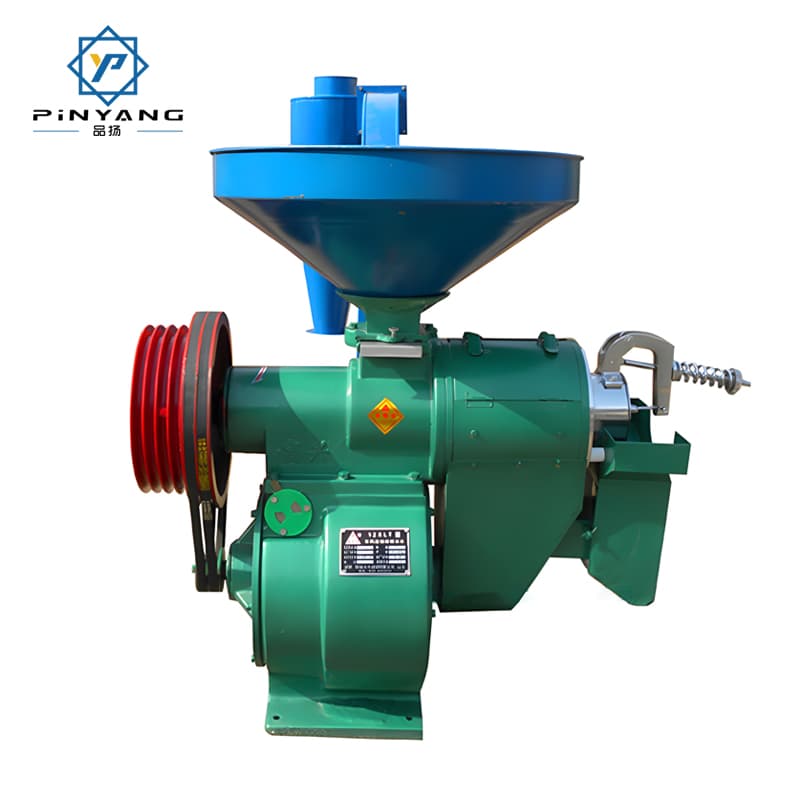
The N90 is a widely used single-stage rice milling machine commonly associated with the Engelberg-type milling system. It is designed to remove the husk and bran through a relatively simple milling process, making it attractive in markets where low machine complexity, familiar operation and repairability matter.
However, the name “N90” does not mean every N90 machine is identical. Machines from different manufacturers and production periods may use different motors, dimensions, screens, shafts, drums and other components.
For this reason, buyers should compare the actual machine configuration rather than relying on the model name alone.
What type of rice mill is the N90?
The N90 belongs to the general family of single-stage or Engelberg-type rice mills.
Unlike modern multi-stage rice milling lines, which separate husking, paddy separation, whitening and polishing into different operations, an Engelberg-type machine performs more of the milling work inside a relatively simple milling chamber.
This makes the machine mechanically simple, but also creates limitations in rice quality and grain breakage.
IRRI notes that traditional single-stage Engelberg steel mills typically have lower milling recovery and substantially lower head-rice recovery than two-stage or modern multi-stage systems.
What is the capacity of an N90 rice mill?
This question needs two different answers.
Published or rated capacity
Previous Ethiopian research and supplier information cited in a 2026 Fogera study placed typical N90 capacity at approximately:
800–1,300 kg of paddy per hour.
Field-observed capacity
The same 2026 study found something very different when existing machines were examined in the Fogera Plain.
Among 55 N90 machines, the reported average actual milling capacity was approximately:
601.5 kg/hour
with observed values ranging from approximately:
479.6 to 625 kg/hour.
The researchers specifically noted that observed capacity was significantly below earlier reports and manufacturer figures.
This difference matters.
Real rice mill capacity depends on:
- machine wear
- paddy condition
- grain variety
- moisture
- feed rate
- screen condition
- belt condition
- motor performance
- machine adjustment
- operator experience
Therefore, do not choose a machine only by the number printed in a brochure.
Where is the N90 still commonly used?
One important example is Ethiopia's Fogera Plain.
A 2024 survey published in 2026 found that N90 machines accounted for approximately 42.64% of surveyed milling machines, making N90 the largest individual model group in the study. NX110 accounted for another 18.60%. Engelberg-type machines collectively represented about 75.97% of surveyed mills.
This installed base creates continuing demand for:
- N90 replacement machines
- spare parts
- repair knowledge
- compatible components
- machine upgrades
Common N90 wear parts
Field research in Fogera identified several important N90 wear and failure areas.
Reported worn parts included:
- polisher drum
- screen / sieve
- belt
Frequently failing systems also included milling chamber and blower components such as:
- drums
- rollers
- screw rollers
- bearings
- blower fan components
Advantages of an N90
An N90 may still make sense where buyers value:
- simple mechanical construction
- familiar operation
- existing mechanic experience
- an existing N90 spare-parts ecosystem
- small-scale custom milling
- lower system complexity
Limitations of an N90
An N90 may be a poor choice if your business requires:
- consistently high head-rice recovery
- low broken-rice levels
- premium finished rice
- higher automation
- larger continuous throughput
- controlled separation of husk, brown rice and polished rice
In those situations, a two-stage rubber-roll system or a modern multi-stage line may make more economic sense.
Should you buy another N90?
Do not start with the machine.
Start with your business.
Before choosing an N90, determine:
- paddy processed per day
- target finished-rice quality
- current broken-rice rate
- available electricity
- operating hours
- local spare-parts availability
- current machine model
- whether this is a new installation or replacement